RootPay

Taking the card is the easy half.

What separates a payments feature from a payments system is whether you can answer where the money went after the card cleared.

RootPay
30×the margin spread an uncapped percentage puts between a $400 treatment and a $12,000 case
97.4%of card volume reached the bank in the demonstration window, with the rest itemized
4figures every payout row reconciles: payments, refunds, fees, deposited
6states an invoice can hold, so a balance is never a guess
Collecting

Deposits, plans, memberships, invoices.

An accepted quote becomes an invoice without anybody retyping a line item or a price.
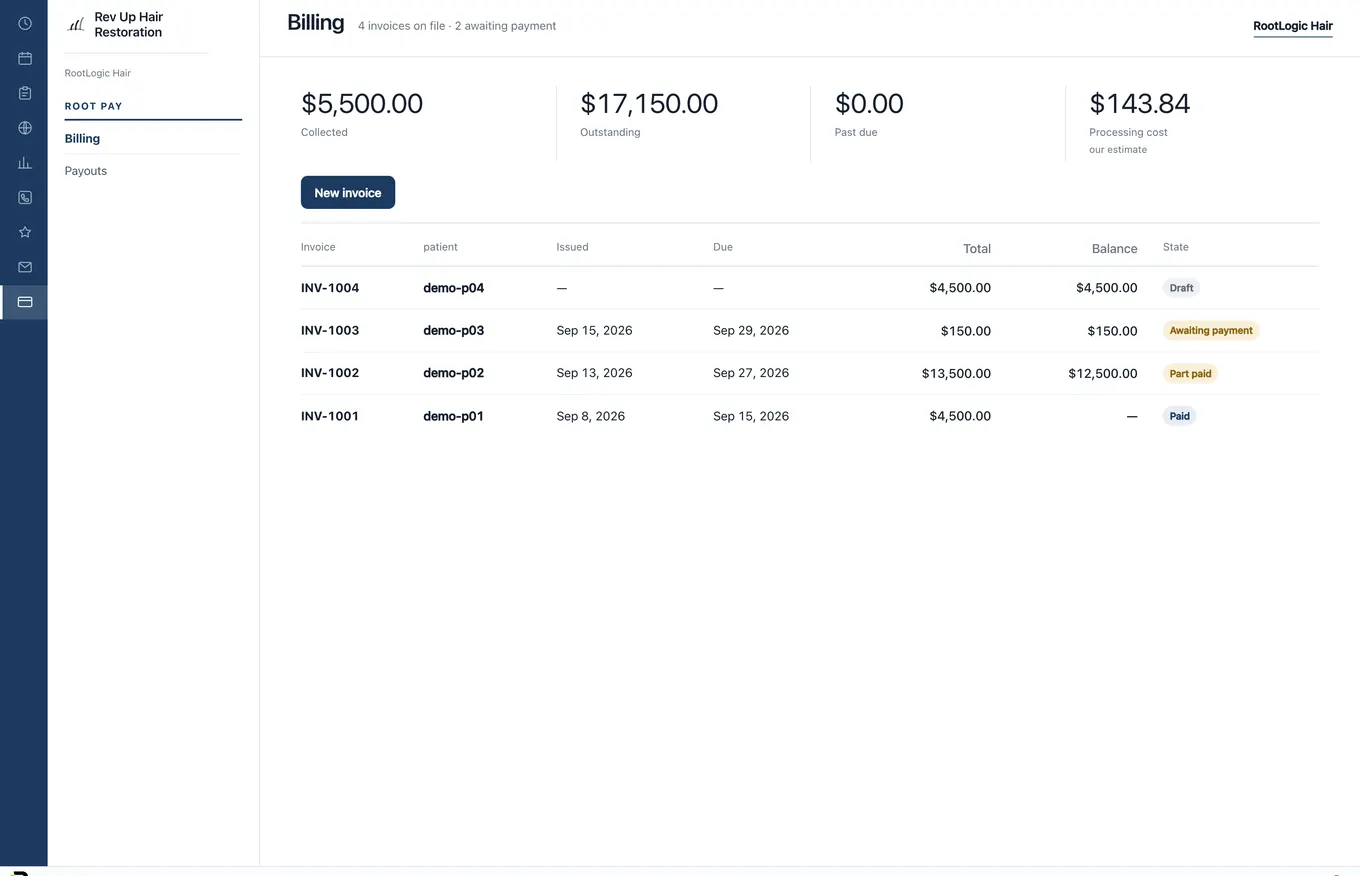
RootPay billing: every invoice with its live balance
Every invoice with its live balance and state. Demonstration data.
Settling

Where the card money actually goes.

A deposit is not revenue until it lands. RootPay shows which charges made up a payout, what the processor took, and the date the money actually arrived.

Payouts can be negative. When refunds exceed charges the processor debits the account, and a system that cannot represent that quietly drops the day.
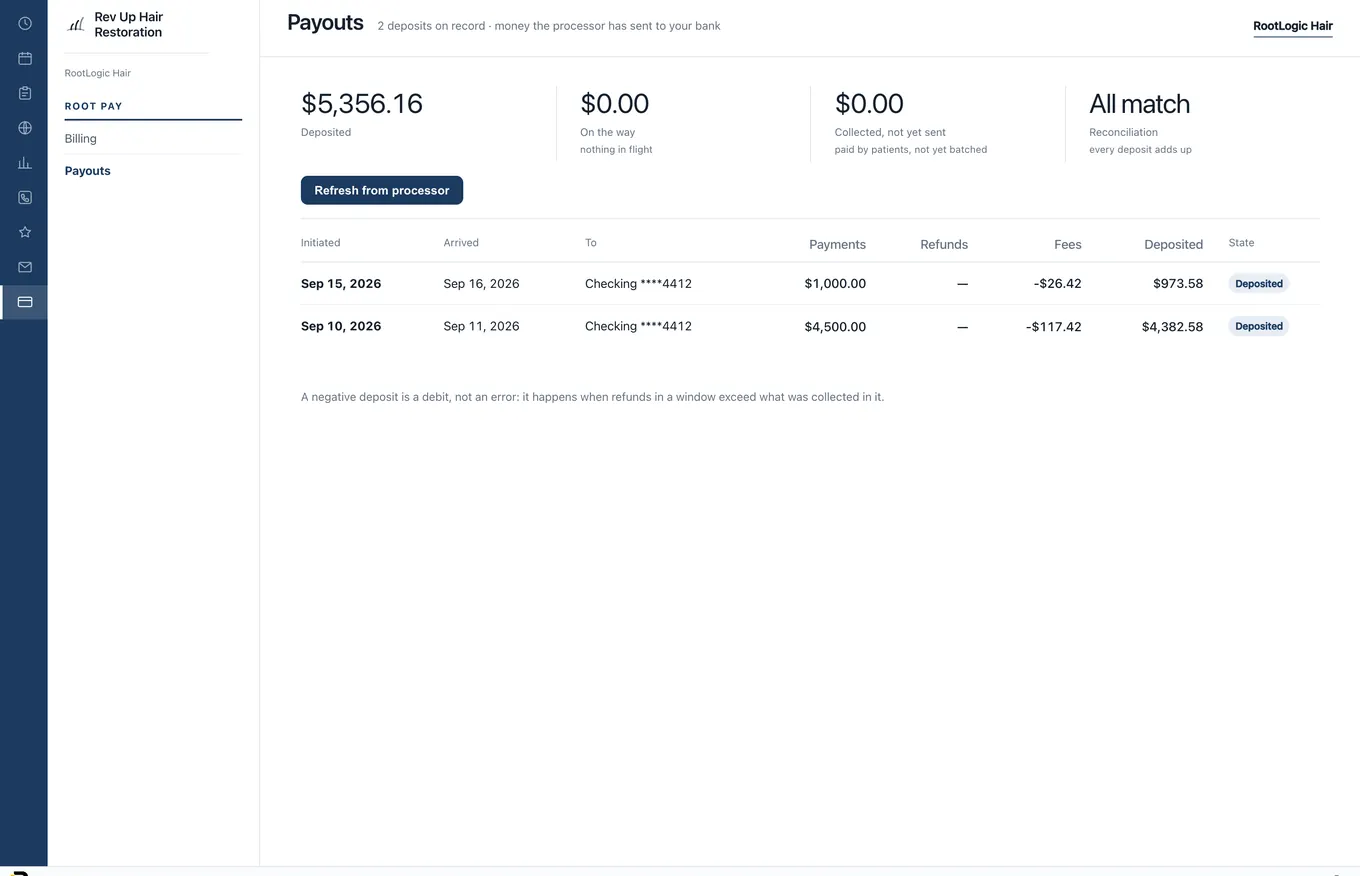
RootPay payouts: each deposit with its payments, refunds, processor fees and the date the money arrived in the practice's bank account
Payouts, with the settlement date rather than the forecast. Demonstration data.
$5,500.00Card volume, demonstration window
97.4%Reached the practice's bank: $5,356.16 (97.4% of Card volume, demonstration window)Processor fees, itemized per payout: $143.84 (2.6% of Card volume, demonstration window)
Reached the practice's bank$5,356.16 · 97.4%
Processor fees, itemized per payout$143.84 · 2.6%
The two deposits shown above, added up: $1,000.00 and $4,500.00 charged, $26.42 and $117.42 taken in fees, $5,356.16 arrived. Demonstration data, and the arithmetic is the point rather than the amounts - every cent between the charge and the deposit is on a row you can open. The fee figures in the demonstration tenant are the product's own computed estimate, which is what it shows until a processor reports real fees against a payout; the screen labels which of the two it is holding.
The rate

Disclosed, and capped.

Card processing is billed on volume at a disclosed rate, with our margin capped per transaction. The cap matters here: on a twelve thousand dollar surgical deposit, an uncapped percentage is a number nobody would agree to out loud.

A margin charged as a percentage of volumeRootLogic, capped per transactionthe cap
Our margin, relative to our margin on a $400 transaction
the cap
1×A margin charged as a percentage of volume: 1×
1×RootLogic, capped per transaction: 1×
$400
treatment
3×A margin charged as a percentage of volume: 3×
1×RootLogic, capped per transaction: 1×
$1,200
package
11.25×A margin charged as a percentage of volume: 11.25×
1×RootLogic, capped per transaction: 1×
$4,500
procedure
30×A margin charged as a percentage of volume: 30×
1×RootLogic, capped per transaction: 1×
$12,000
surgical deposit
A margin charged as a percentage scales exactly with the amount charged, so the same card, swiped for the same work, earns the processor thirty times more on a surgical deposit than on a treatment. Drawn with the cap set at the $400 transaction's margin so the two series start level; where the cap actually sits is disclosed to you in writing before onboarding rather than published here. The fixed per-transaction component is excluded, because it does not scale and including it would flatter the figure.
30×

Same card, same work, thirty times the margin

That factor is the ratio of the two ticket sizes and holds at any percentage rate, which is what makes it checkable. A cap is the only thing that stops it.

100%

Of the merchant relationship stays with the practice

The account is your own, the same as your phone number and your ad accounts, and stored credentials are portable at the processor level.

$0

Added to your subscription when volume grows

Processing is billed separately from the subscription at $399 per location. A good month should not make your software more expensive.

Whose account it is

The question everything else in this page depends on.

A practice held through its card vault is a practice that cannot leave. So the merchant account is the practice's own, and the answers below are terms rather than reassurance.

A practice owner standing in her own reception area

Your account, your patients, your number

Every other claim on this page is downstream of this one. If the merchant relationship sat with us, the rate would be ours to move and the card vault would be ours to hold.

  • The merchant account is in the practice's name
  • Stored credentials are portable at the processor level
  • The subscription does not move with volume
  • Month to month, with no termination fee
Who holds the merchant relationship?

The practice. The account is your own, the same as your phone number and your ad accounts.

What happens to card-on-file if we leave?

Stored credentials are portable at the processor level. We will not hold a practice through its card vault.

Does the subscription move with volume?

No. A good month should not make your software more expensive.

Is live processing on from day one?

No. Live processing activates after merchant onboarding, which is a decision the processor makes about your practice and not one we can make for you.

Before it is a payment

It is a conversation at a desk.

Most of what decides whether a deposit gets taken happens before anybody touches a card reader: whether the quote was itemized, whether the patient was sent something they could open, whether the front desk had to ask twice.


Three practice staff talking easily together at a front desk
The front desk, where the deposit is actually asked for.
Two people in conversation across a table in a bright office
The quote conversation, which decides whether there is a deposit to take.
Next

Open the product before you talk to anyone.

The demo tenant is a working RootLogic on demonstration data. Click the pipeline, open a case, read a quote, look at where the revenue came from. No form, no call.