Day zero to day thirty.
Day zero is the day the agreement is signed. Weekends are not counted against you: every figure below is a business day, and the dates move together if one slips.
- Day 0Meeting
Kickoff call, 60 minutes
The owner and whoever runs the front desk. We leave with your service list and prices, the stages a patient actually moves through at your practice, the users and what each of them should be able to see, and the current phone bill.
- Day 1We build it
Your tenant exists
Account created, users invited, roles set. From this point there is somewhere to put work, which is why it is first rather than last.
- Day 1Waiting on a third party
The number port is filed
Filed on day one whatever the go-live date is, because it is the only item on this page with a clock we do not control. Carriers take one to four weeks.
- Days 2 to 4We build it
Catalog, stages, quote templates
Your services and prices as a real catalog rather than a price list, the pipeline stages proposed from your vertical, and the quote templates a coordinator will send. Built from what you gave us at kickoff, not from a generic template.
- Day 5Meeting
Configuration review, 30 minutes
You look at what was built and change it. Prices, stage names, who sees what. This is the cheapest hour in the whole thirty days, because everything downstream is reported against these definitions.
- Days 6 to 8We build it
Your patients arrive
Contacts imported from whatever holds them today and deduplicated on a stable identifier rather than on a name. We print what merged and what did not before anything is committed.
- Day 9Your decision
Every named user signs in once
Not a lesson, a proof. A login that has never been used is a login that does not work, and week three is the wrong time to find out.
- Days 10 to 13We build it
Capture is wired
Web forms repointed so submissions land here, call recording on, the booking link live, and every old booking surface enumerated. Old surfaces are the ones that quietly keep taking appointments after everyone has moved.
- Day 12Meeting
Front desk training, 60 minutes
The people who will live in this, not the owner. One board, one place to answer a message, one way to send a quote. Recorded, so somebody hired in March can watch it.
- Day 14Waiting on a third party
The number answers here
Typical. It can land as early as day seven or as late as day twenty-eight, and it is the reason a go-live date is stated as a range until the carrier confirms.
- Day 15Goes live
Go live
The board becomes how work happens, and the old booking surfaces are switched off the same day. Nothing runs in parallel, because parallel means neither.
- Days 16 to 27We build it
We watch it with you
The first two weeks of real use are when configuration meets reality. Stage changes, catalog corrections and routing fixes are expected in this window and are not a sign anything went wrong.
- Day 21Meeting
Week-one check, 30 minutes
What the front desk is actually doing versus what the board says. Anything awkward gets fixed now rather than becoming how your practice works.
- Day 28Meeting
Reporting session, 45 minutes
Taught last, on purpose, and on your own month of data. Sources, consult rate, what a campaign produced in collected revenue.
- Day 30Goes live
Onboarding ends
You move to a scheduled check-in rather than an implementation. Support stays the same address it was on day one.

All of them, with who needs to be there.
Five, totalling three and a half hours across a month. Anyone who cannot make one gets the recording; nothing here is a meeting for its own sake.
| When | Meeting | Length | Who from your side | What it produces |
|---|---|---|---|---|
| Day 0 | Kickoff | 60 min | Owner, front desk lead | Catalog, stages, users, the phone bill |
| Day 5 | Configuration review | 30 min | Whoever can approve prices | Signed-off configuration |
| Day 12 | Front desk training | 60 min | Everyone who touches a patient | A recording your next hire watches |
| Day 21 | Week-one check | 30 min | Front desk lead | A fix list, worked the same week |
| Day 28 | Reporting session | 45 min | Owner, marketing lead if you have one | Your own numbers, read correctly |
The day-28 session is booked before you go live
A teaching session scheduled after go-live competes with your first busy week and loses. It carries a real date on a real calendar before the switch is thrown, which costs nothing and is the only thing that makes it happen.


Every one of these is a video call with a person who can change the software, not a webinar and not a ticket queue. They are recorded, so the member of staff who could not be there, and the one you hire in March, both get the same session.
The account, phase by phase.
A reasonable question at any point in the month is what you would actually be holding if everything stopped that day. This is the answer.
| By the end of | What is in your account |
|---|---|
| Day 5 | The tenant, your users and roles, your service catalog with real prices, your pipeline stages, quote templates. |
| Day 9 | Everything above, plus every patient you have today with their history, deduplicated, and a login proven to work for each named user. |
| Day 14 | Plus live capture: forms posting here, calls recorded and matched, online booking open, your number ported or a temporary number answering. |
| Day 21 | Plus a week of real work on the board: opportunities, quotes sent, messages threaded to the person, a closed set of old booking surfaces, and every self-pay quote showing whether it is owed a written estimate. |
| Day 30 | Plus a month of your own data behind the reporting, which is the first point at which any of it is worth reading. |
Yes, and here is exactly how far.
Short answer: about ten business days to live is the floor, and two things on this page will not move no matter what anybody is paid.
What is the actual fastest you have gone live?
Ten business days, and it needs three things to be true: your service list and prices arrive at kickoff rather than a week later, one named person can approve configuration without convening anybody, and you either launch on a new number or you already control the port.
Tell us at kickoff that you are building to a date. We would much rather sequence around it than find out in week two.
Which parts cannot be compressed?
Two. The number port is a carrier process, one to four weeks, and no amount of urgency on our side changes it. The reporting session needs a month of your own data behind it, and holding it early does not make it earlier, it makes it useless.
Can we go live before the number ports?
Yes, and it is the single biggest lever you have. You launch on a new tracked number, everything else runs normally, and the port lands behind you without a second go-live. Your published number keeps working the entire time.
Can we skip the front desk training?
No, and it is the one we would push back on hardest. Every failed rollout we have watched failed in the same place: the owner understood it and the front desk was never taught it. It is sixty minutes and it is recorded.
We have several locations. Does that change the timeline?
Not if you start with one. One location live on day fifteen and the rest following a week apart is faster in practice than all of them at once, because the second location inherits every correction the first one found.
What if we are mid-campaign and cannot pause anything?
Nothing here requires you to pause advertising. Forms are repointed in an afternoon and the old destination keeps receiving until the moment it does not.
So nothing sits in the gap between two people.
Every row has exactly one owner. Where a row is yours, it is because it genuinely cannot be ours.
| Task | Us | You |
|---|---|---|
| Tenant, users and roles | Set up | Confirm who gets what |
| Catalog and prices | Built with you | Supply the list |
| Pipeline stages | Proposed from your vertical | Approve or change |
| Contact import | Run and deduplicated | Point us at the source |
| Number porting | Filed and chased | Authorise it, supply the current bill |
| Form repointing | Done, where we have access | Access, or your developer's email |
| Old booking surfaces | Enumerated | Confirm which can be switched off |
| Front desk training | Delivered and recorded | Get the people in the room |
| Reporting | Taught on day 28 | Tell us which numbers you are judged on |
| Good faith estimates | Switched on and templated | Confirm the wording you want on them |

Four, and three are avoidable.
Said plainly because naming them in week one is how they stop happening.
- The catalog never arrives
- The most common delay by a distance. Everything downstream is defined against your services and prices, so a week of silence here is a week added to the end.
- Approval needs a meeting nobody has booked
- Configuration review takes thirty minutes and stalls for nine days waiting for the one person who can say yes to prices.
- The website is somebody else's
- Repointing a form needs access. If it lives with an agency or a developer, that introduction is worth making on day one, not day ten.
- The carrier
- The one that is not avoidable. It is why the port is filed on day one and why going live on a new number is offered.
None of these are discovered late. Each one is checked at kickoff and again at the configuration review, and you are told the day a date is at risk rather than the day it is missed.
The screen you did not have on day one.
Every patient in an elective practice is self-pay, which is exactly who the No Surprises Act attaches a written estimate to. It is not an insurance rule you sit outside of. It is the rule for practices like yours, and until something counts them, nobody in the building knows how many are outstanding.
Estimates are switched on and templated during Foundation, so by the time a quote is going out in week three this screen is already keeping the count.
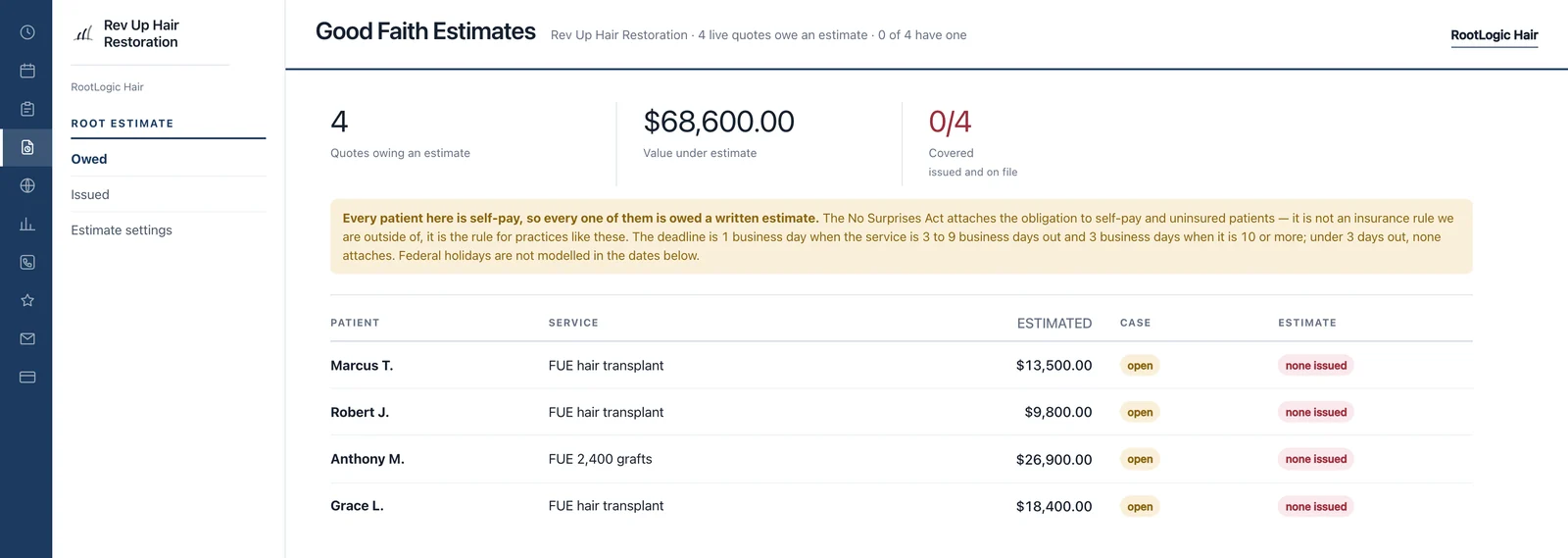
- One business day when the service is 3 to 9 business days out
- Three business days when it is 10 or more
- Under 3 days out, no estimate obligation attaches
- Issued estimates stay on file against the case they were issued for
It reads 0 of 4 the day it is switched on
That is the point rather than a defect. The obligation existed before the software did and nothing was counting it. Thirty days is how long it takes to go from not knowing that number to watching it.