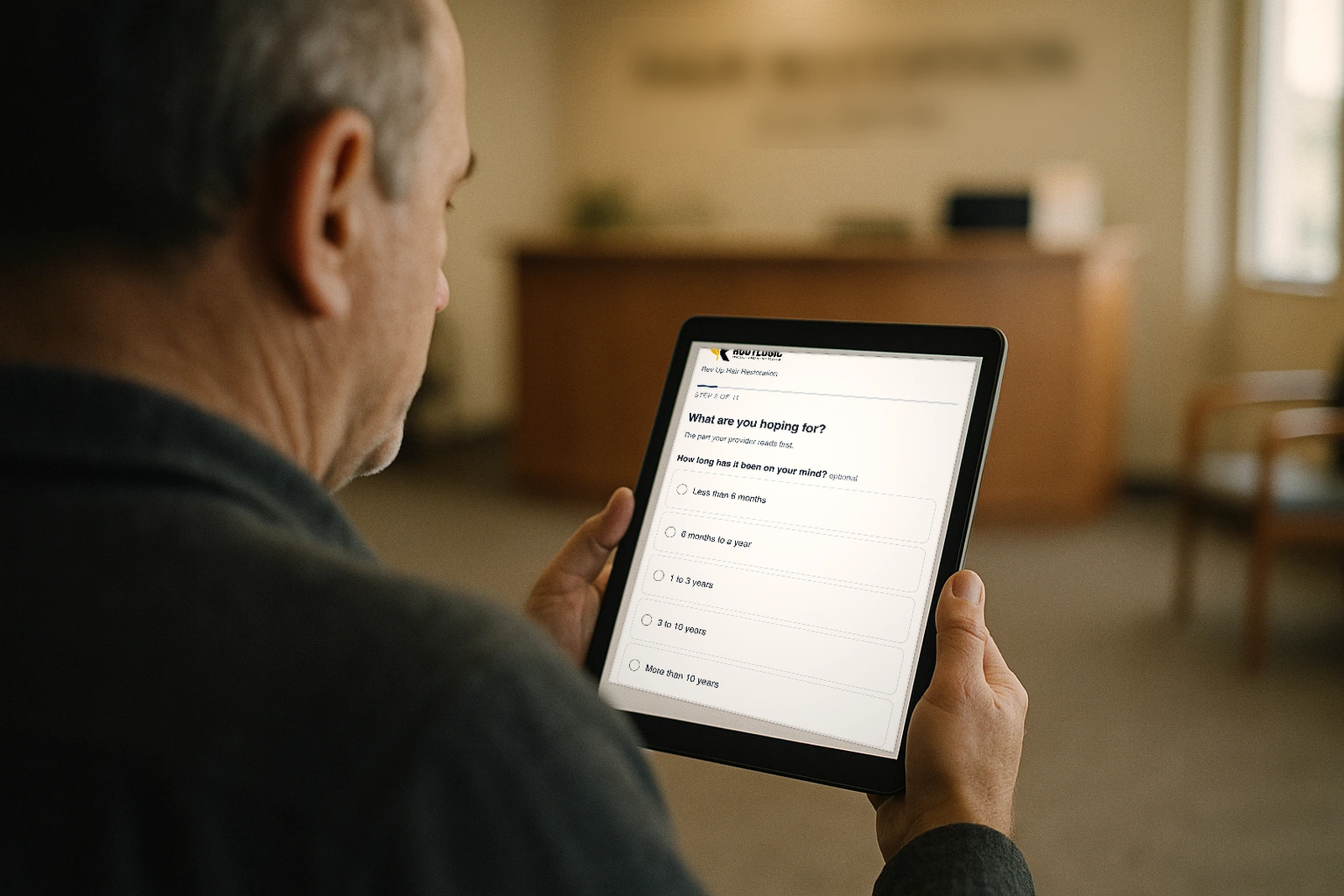
The consultation starts in the waiting room.
About four minutes, on their own phone before they travel or on a tablet at the front desk. How long it has been on their mind, whether they have consulted anywhere else, what a great result looks like to them, and how close they are to deciding. It lands on the record before the provider walks in.
Nobody built software for this.
When we inventoried hair restoration it had no first-class software at all. Practices run a general CRM with the clinical work in free-text notes, a phone system from a third vendor, and an ad account that cannot see either. The listicles are so thin that several of the products they recommend do not exist.
The shape that breaks everything else
A patient researches for months, sometimes years. Then they make exactly one phone call, and whoever answers it decides whether a five-figure case happens.
That breaks most practice software twice. The patient's final search was for your own name, so the channel that gets the credit is almost never the channel that did the work. And the conversion surface is the front desk rather than the website, so the thing you most need to measure is a conversation nobody recorded.

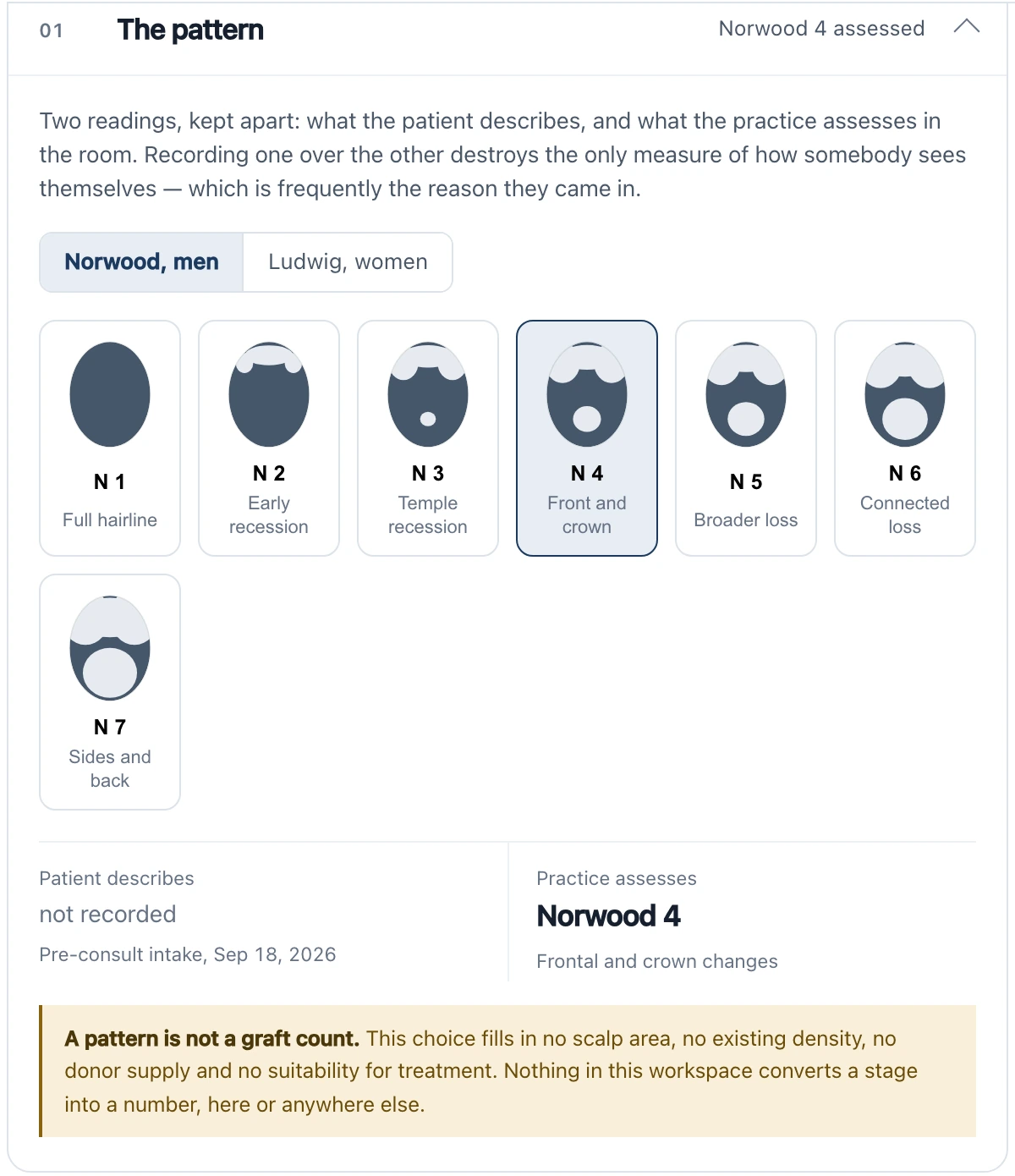
Norwood and Ludwig are staged by the practice, never by the patient.
A grade on the record, chosen from a drawn scale by whoever is in the room. What the patient said about themselves is a different field, and the workspace refuses to let one overwrite the other.
The scale sits on the patient record, not in a drawer
Seven stages with the A-variants, drawn as parametric illustration rather than seven bitmaps, so a Norwood IV looks identical in the room, on the record and on anything printed for the patient. The chart that appears is decided by the recorded sex, and a patient nobody classified gets asked rather than guessed at.

Two readings, kept apart
The workspace carries Patient describes and Practice assesses as two separate fields on the same card. Recording one over the other destroys the only measure of how somebody sees themselves, which is frequently the reason they came in.
And it refuses the inference everyone else makes: a pattern is not a graft count. Choosing a stage fills in no scalp area, no existing density, no donor supply and no suitability for treatment. Nothing in the workspace turns a stage into a number.
Pictured: step 01 of the consultation, staged at Norwood 4 by the practice. Demonstration data.
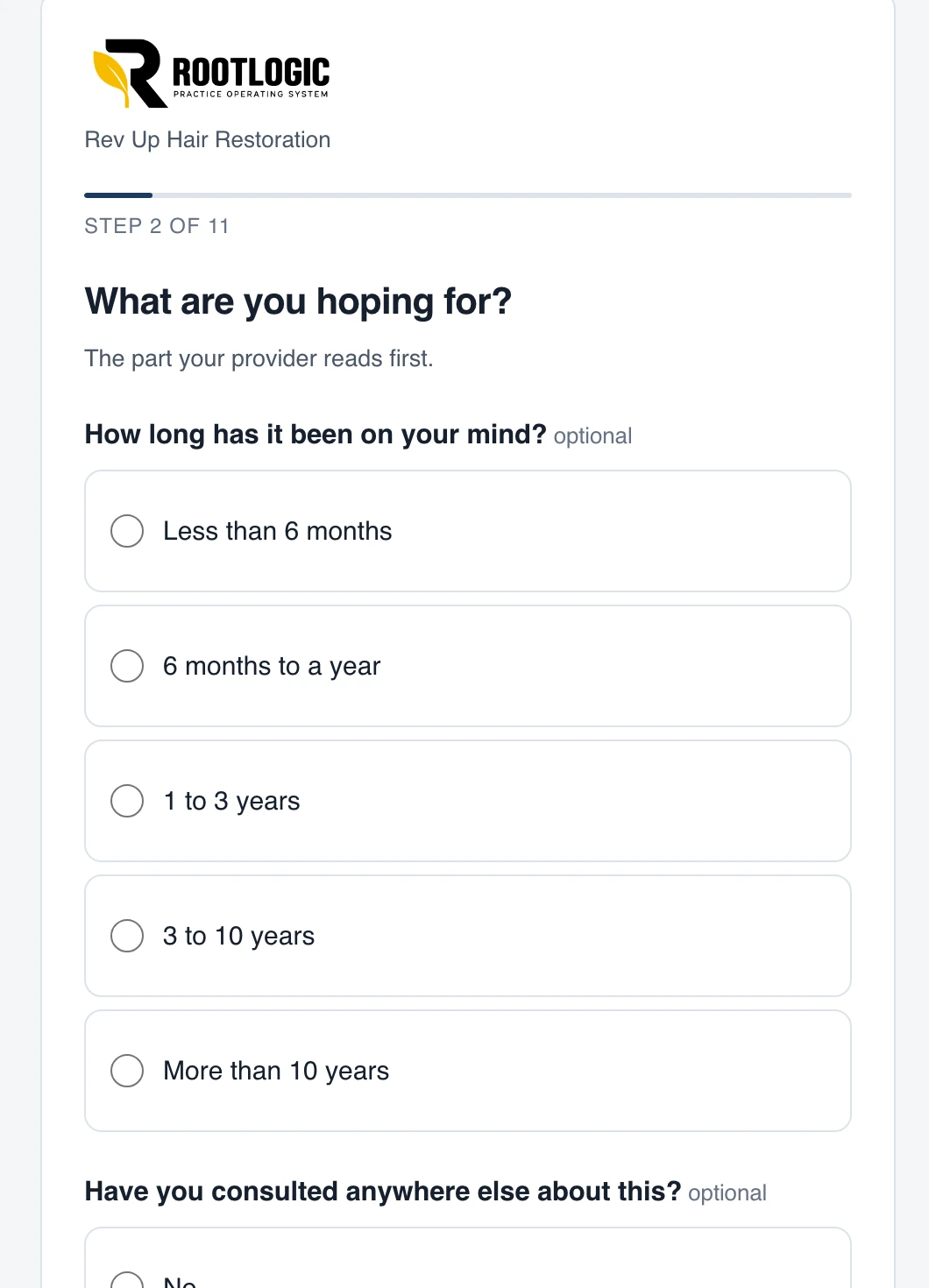
Five steps, and not one of them is a health question.
What a live practice sends is goals, timing, priorities and attribution. The clinical steps you can see in the demo tenant are fenced off from every medical practice in the database, not by policy but by a constraint.
What it actually asks
- What are you interested in, from the practice’s own service catalog
- How long has it been on your mind, and what is behind it
- Have you consulted anywhere else about this, and how did it go
- What would a great result look like to you
- When would you ideally like to go ahead, and around what date
- Where are you in your thinking, and would you like to go through financing
- What matters most — result, safety, downtime, scarring, cost, privacy
- How did you first hear about us, and what made you book
Which is a sales conversation, not an intake form. Have you consulted anywhere else and where are you in your thinking are the two answers a coordinator would pay for, and the provider reads them before they open the door.
Health questions are withheld from a medical practice's questionnaire because the store underneath it carries no BAA for them. That is enforced in the database rather than left as a setting somebody can switch on. Medications, allergies and conditions are recorded in the room, in the workspace, where they belong.
What else the pack actually models.
Six more objects a general CRM has no concept of, which is why all of it ends up in a notes field nobody can report on.
- Donor assessment with density and laxity recorded at consultation, not estimated afterwards
- A graft planner that shows its arithmetic and withholds the total while a region is incomplete
- Graft yield at follow-up stored separately from the pre-operative estimate, two fields and never one
- FUE and FUT on the case, because it changes the donor plan, the recovery pathway and the photo schedule
- Six fixed angles per timepoint across a multi-year photo pathway, with shock loss a labeled stage rather than a surprise

Your other revenue lines run on the same spine.
Almost nobody in this vertical is hair-only. There is the surgical case, and then there is non-surgical, topicals and retail, memberships, and whatever second line the practice has added. A system that only understands grafts runs a third of your practice.
Vertical-agnostic, and runs today
- Your own catalog: any service, any price, any category, added alongside the pack and never overwritten by it
- Memberships and programs that renew, and retail units tracked against what was actually used
- The phone line, the recordings and the qualified verdict, whatever the call was about
- Quotes, deposits, payment plans, invoices and reconciled payouts
- Attribution from click to collected revenue, per service line
Hair-specific, and that is the point
- The consultation workspace, staged on Norwood and Ludwig
- The graft planner and its arithmetic
- Donor assessment, and graft yield held apart from the estimate
- The six-angle, multi-year photo pathway
Said plainly because it is the question that decides this: the clinical instrument is built for one vertical at a time, and hair is the one that is finished. A pack with no instrument is given none rather than being handed the hair one — a plastic surgeon opening a consultation and finding a donor-density calculator is not a cosmetic defect. Where every other vertical stands.
We are not asking you to leave the system you chart in.
Every competitor leads with the electronic record, which means every one of them is asking you to undertake the most disruptive project in your software life in order to buy a marketing improvement. You have probably lived through one migration and remember what it cost.
| Stays where it is | Moves into RootLogic |
|---|---|
| Clinical charting, templates and encounter notes | The phone line, recorded and attributed |
| Prescribing, labs and device integration | Leads, consultations and cases on one board |
| Insurance claims and coding | Quotes, financing status and invoices |
| Historical clinical records | Payments, memberships and reconciled payouts |
| Whatever your staff already know | Attribution, click to collected revenue |
The full argument, including what to ask the CRM module your record system already sells you: Keep your chart. What a migration week actually looks like: Switching.
Sold with an agency, without one, or instead of the one you have.
RootLogic came out of an agency, which is why it knows where the numbers break. It is not sold as a reason to hire one. No services requirement of any kind is attached to a subscription.
You own the phone number.
We file the port in the practice’s name, with you as the owner of record, and we hand you the account it sits in. Most practices discover the answer to this question on the day they try to leave. If you leave us, the number goes with you, because it was never ours to keep.
You choose who represents you.
Run your marketing in-house, keep the agency you have, or hire a different one next year. Whoever it is gets the same access to the same data at the same price, and they get it from you rather than from us.
Stop rebuilding the wheel.
Every time a practice changes agencies the same things get rebuilt from nothing: the forms, the tracking, the pipeline, the reporting, the history. That rebuild is not a service, it is a tax on switching, and it is why practices stay somewhere they have already decided to leave.
What that means in terms
| Claim | What it means |
|---|---|
| Your patients | The patient list is yours. Never used to market to anyone, never pooled across tenants, never sold. |
| Your data | A full export of records, conversations, consultations, quotes, invoices and photographs, in an open format, on request. |
| Your number | You own it and you take it. Porting out is a request we fulfil, not a negotiation we open. |
| Your ad accounts | Yours. RootLogic reads them and writes into them; it does not hold them. |
| Your processor | The merchant relationship is your own, and stored card credentials are portable. |
And the five tactics this refuses
- Holding the number. Making a port-out slow or conditional. Your number is your identity to every patient who has ever called you.
- Owning the ad account. The history and the learning leave with whoever holds it. You should be the owner of record, always.
- The contacts-only export. A CSV of names offered as if it were the record. The relationship lives in the conversations and the cases.
- The card vault. Making stored credentials non-portable so switching means asking every patient to re-enter a card.
- Fee-gated export. Charging for the data on the way out. A vendor that does has told you what it thinks the relationship is.
Named because they are common, and because a vendor that will not name them is one you cannot check. The full terms.
We have no customer stories yet, and that is the honest state.
Every competitor page in this category carries four testimonials. Some of them are composites. Ours is empty until a founding practice produces something worth publishing, and these are the three conditions it has to meet before it goes up.
- A named practice, with their written permission
- Numbers out of their own system over a stated window, never a projection
- The sample size and the window printed next to the figure
Two things you can check instead of a testimonial. The demo tenant is open with no form, so open it and click anything in it. And the changelog is dated, which is the only credibility signal a young company actually has — what shipped and when, including the entries that are corrections. Trust and security if that is the question behind the question.

One platform, the whole case.
Five steps, in the order a hair case actually moves through them.
The call is the whole funnel
A hair patient researches for months and then makes exactly one phone call. Whoever answers it decides whether a five-figure case happens. Every call is recorded against the patient record, transcribed, and carries a qualified verdict decided by rules you can read rather than a score nobody can explain.
Open it in the demo →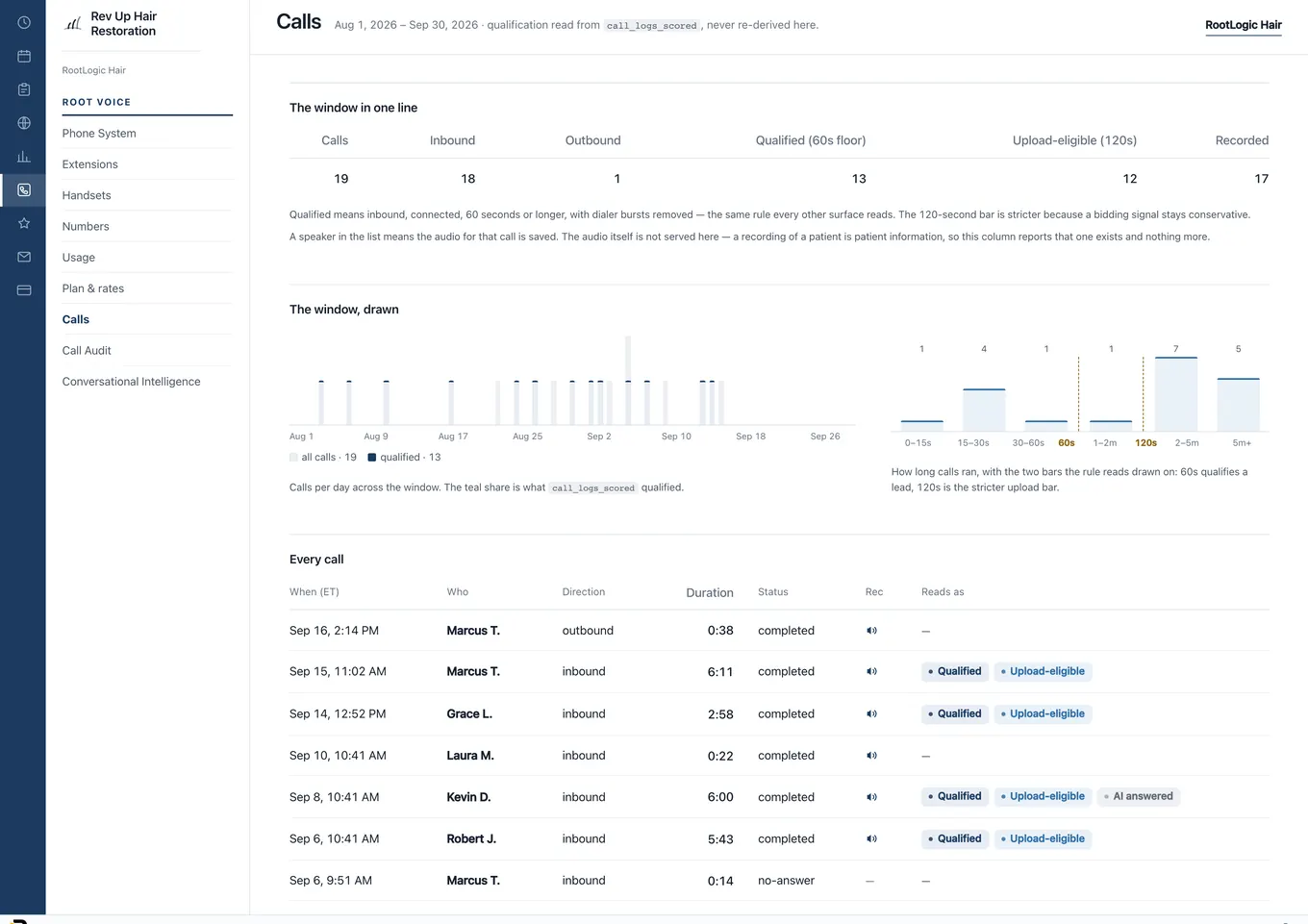
The consultation, recorded properly
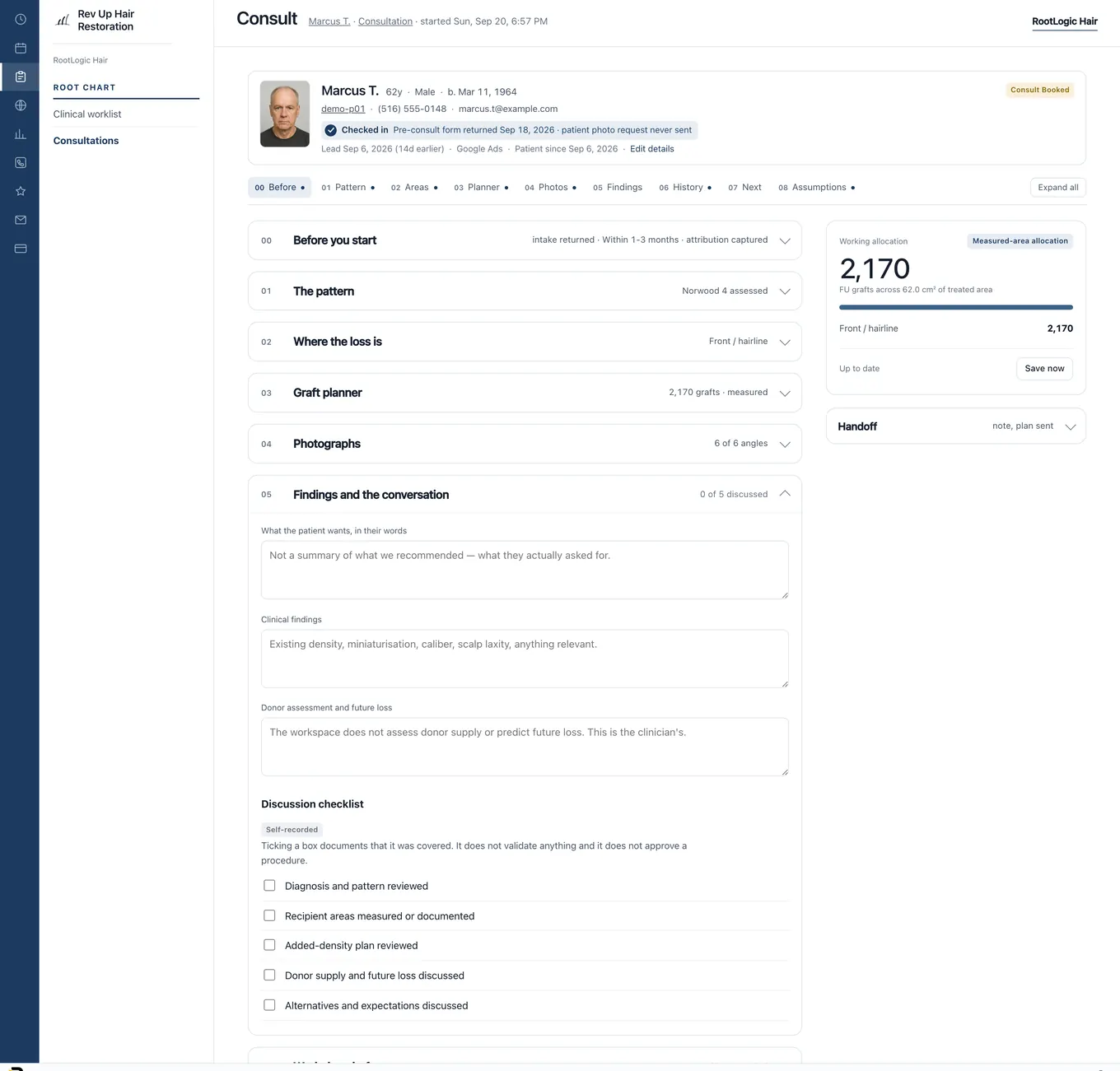
Nine steps behind an anchor menu. Pattern staged on Norwood or Ludwig, with what the patient reported kept separate from what the practice assessed. Scalp regions, donor assessment, findings, and dated prior procedures, so a repair case reads as a repair case rather than a new lead with an unusual history.
Open it in the demo →
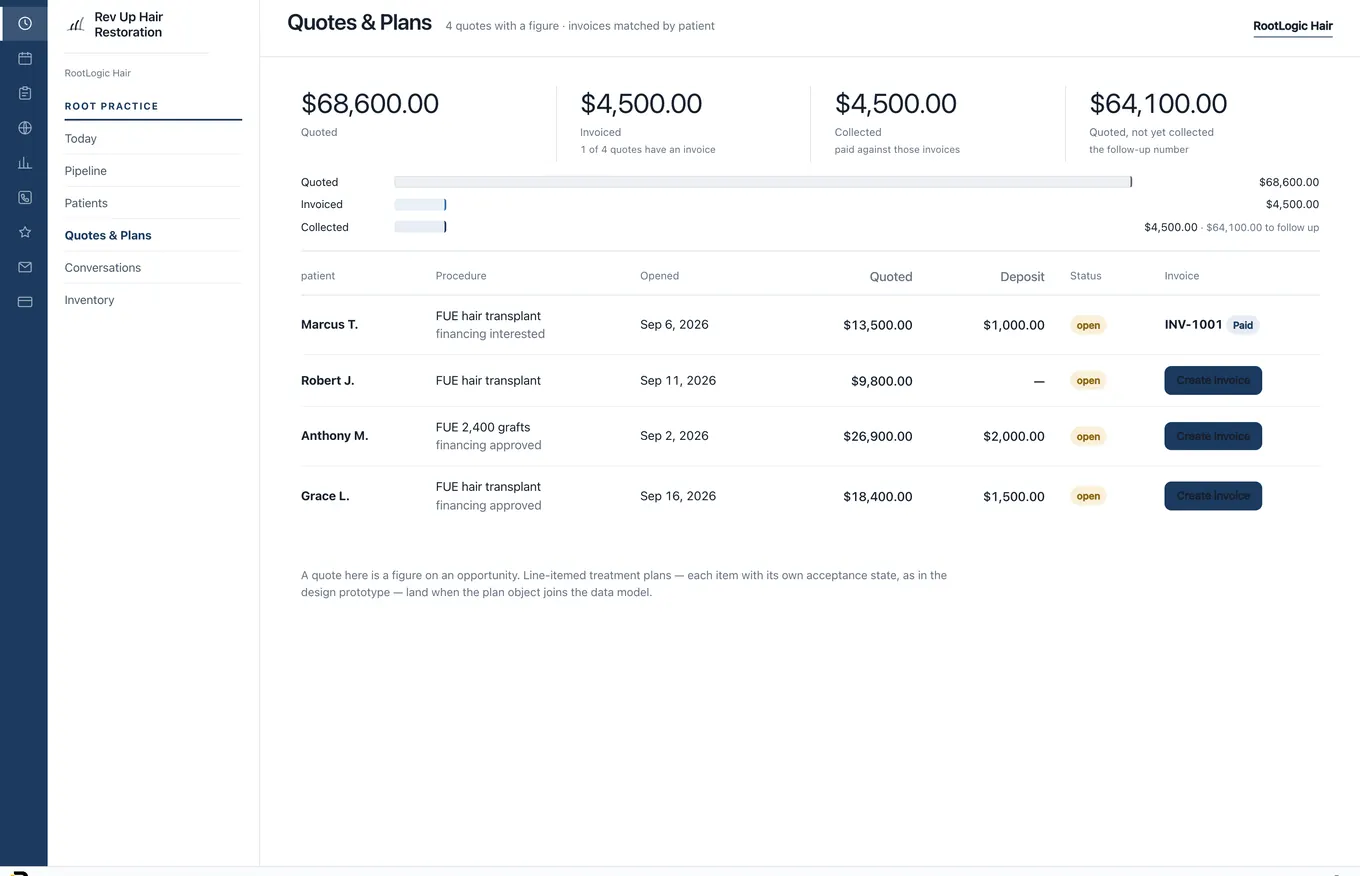
A quote you can still sell
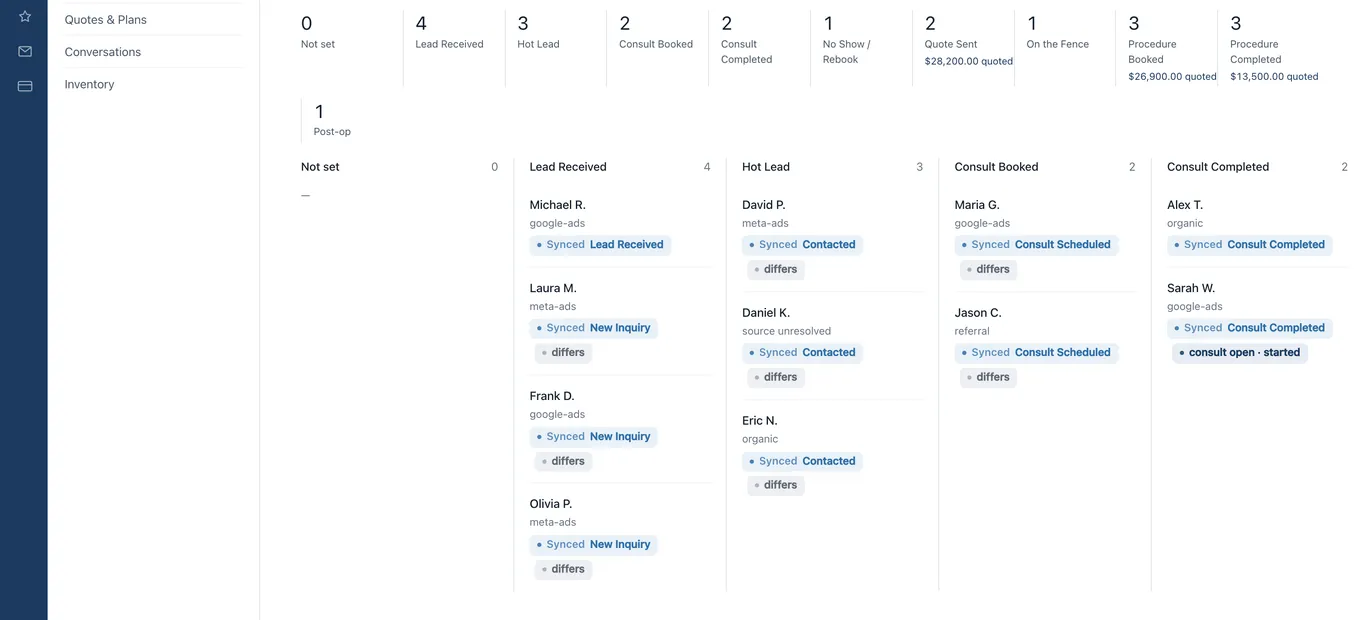
Quoted value sits on the board next to the stage it is stuck in, so the number that matters is not what you billed last month but what is quoted and still sellable this month. Each quote carries the live state of its invoice.
Open it in the demo →
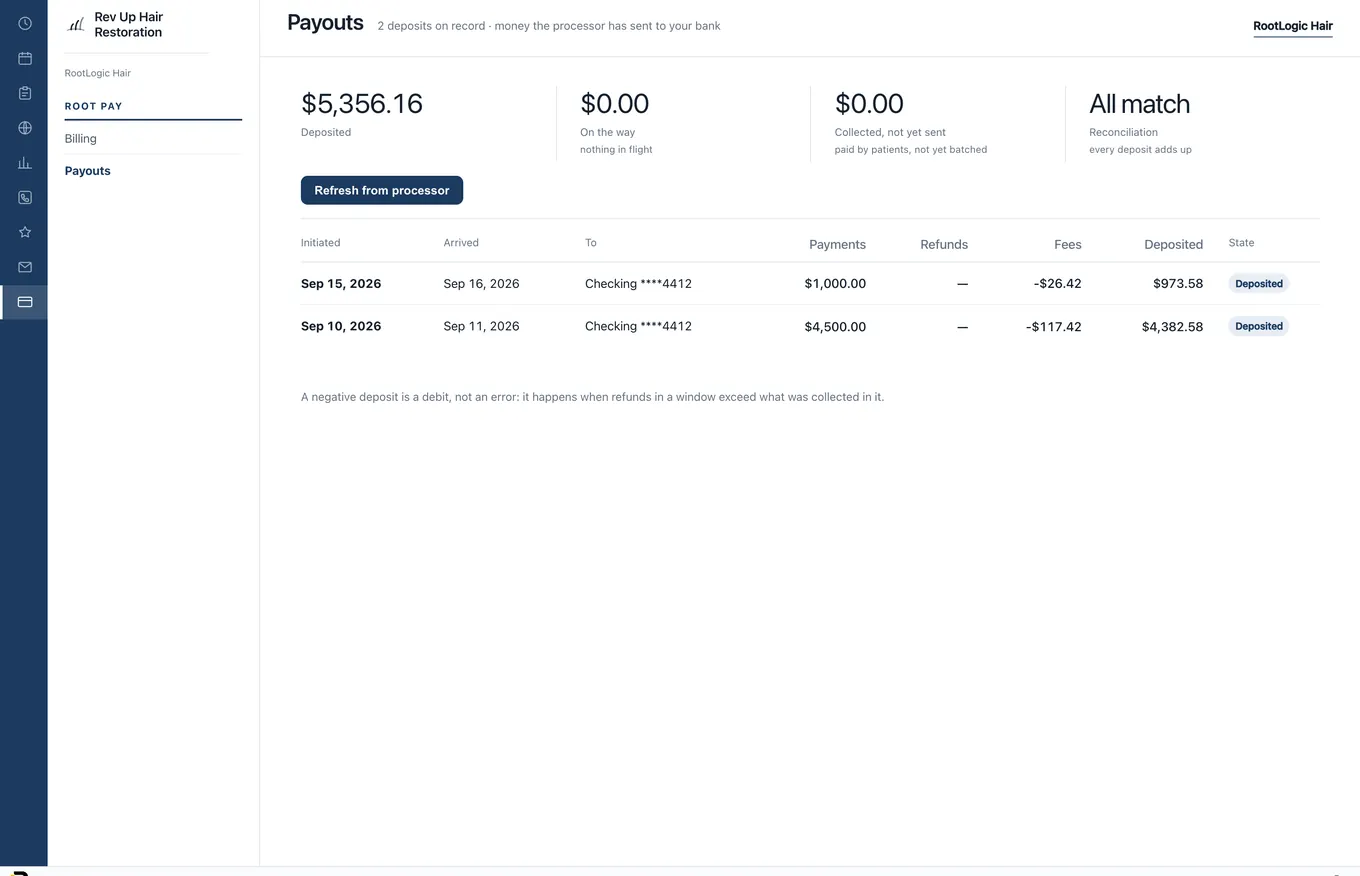
Deposits, plans and what the bank actually received
A graft case is rarely paid in one movement. Deposits, payment plans and the balance each sit on the invoice, and payouts reconcile against what arrived in the account rather than against what the invoice said was collected.
Open it in the demo →
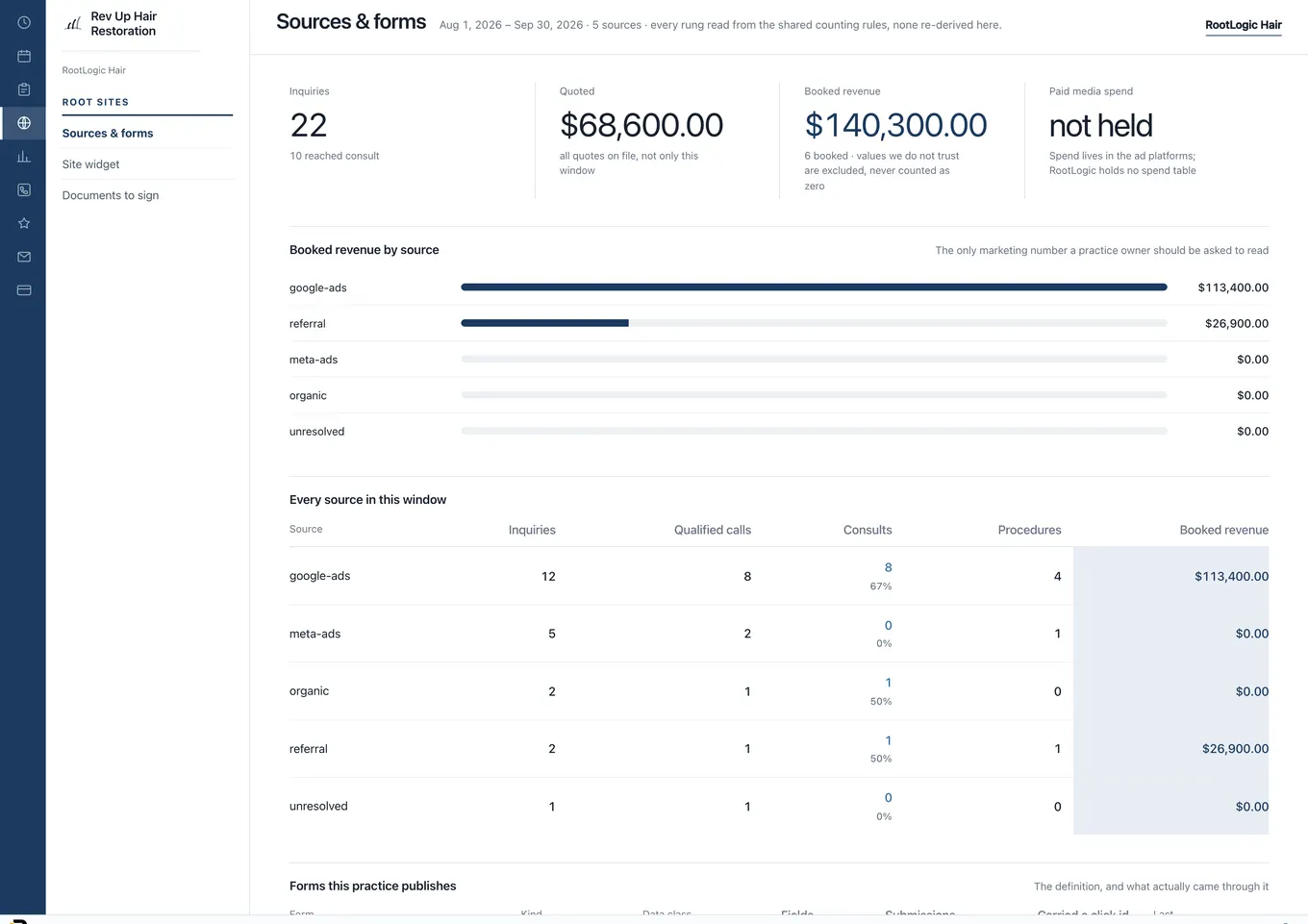
The case lands on the ad that caused it
Collected revenue attributes to the campaign that started the chain fourteen months earlier, not to the branded search the patient ran the night before they called. That difference usually reorders a practice's entire view of which channels work.
Open it in the demo →

The phone line is part of the product, not a partner logo.
A call is the highest-intent event in elective medicine, and in hair restoration it is very close to the only one. It should not live in somebody else's portal with its own login and its own invoice.
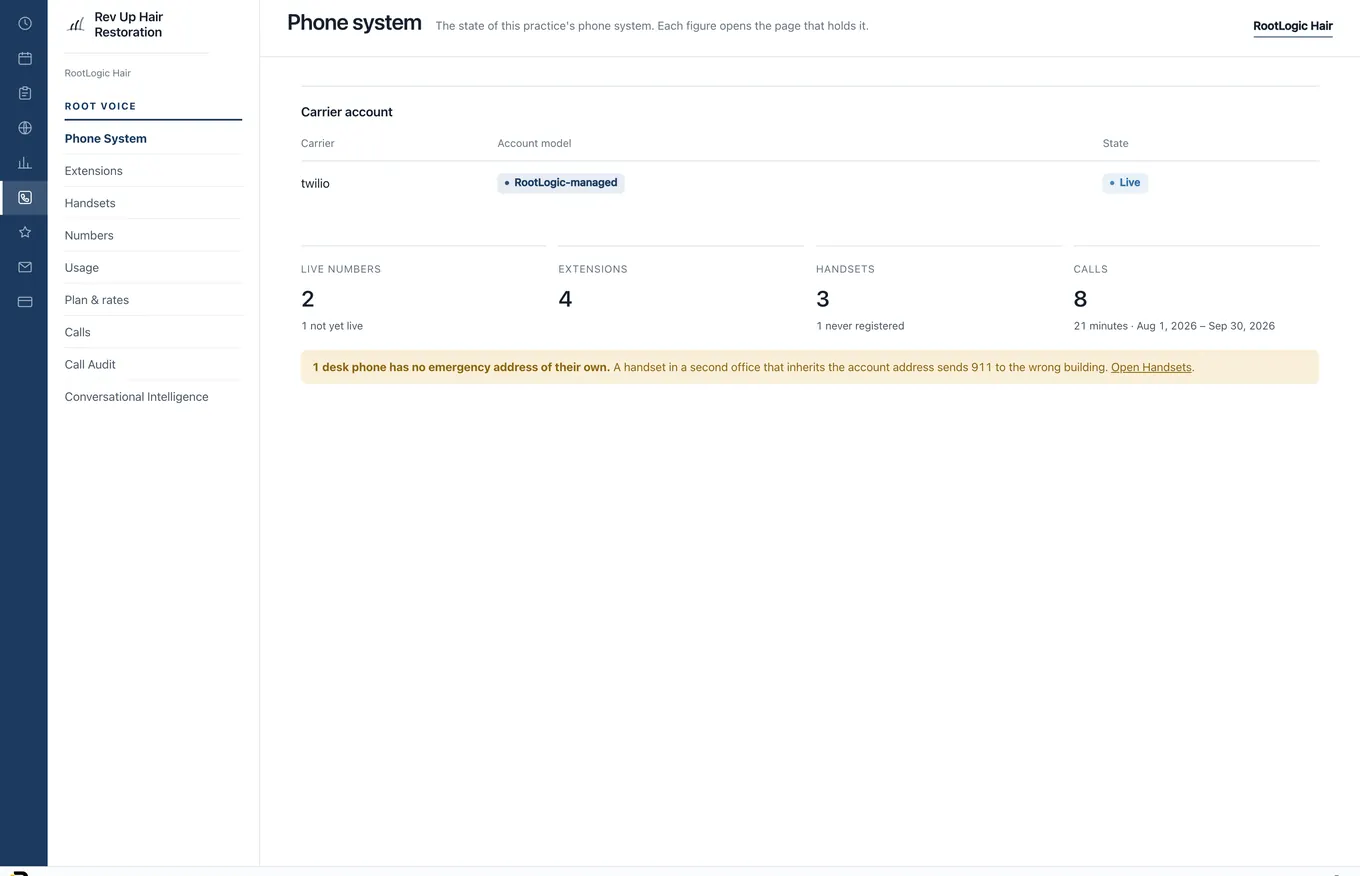
Extensions, handsets, numbers and usage.
Five numbers or extensions and 2,000 talk minutes are included in the $399. Two thousand minutes is about thirty-three hours, which a busy front desk can clear in a month, so it is worth knowing what happens next: usage past it is billed at what the carrier charges us, itemized by line, with no markup and no bundle you have to buy in advance.
The per-minute rate card is not published yet. Ask for it before you sign and we will send the carrier’s own numbers, which we would rather do than point you at a page that does not carry them.
What registers against it
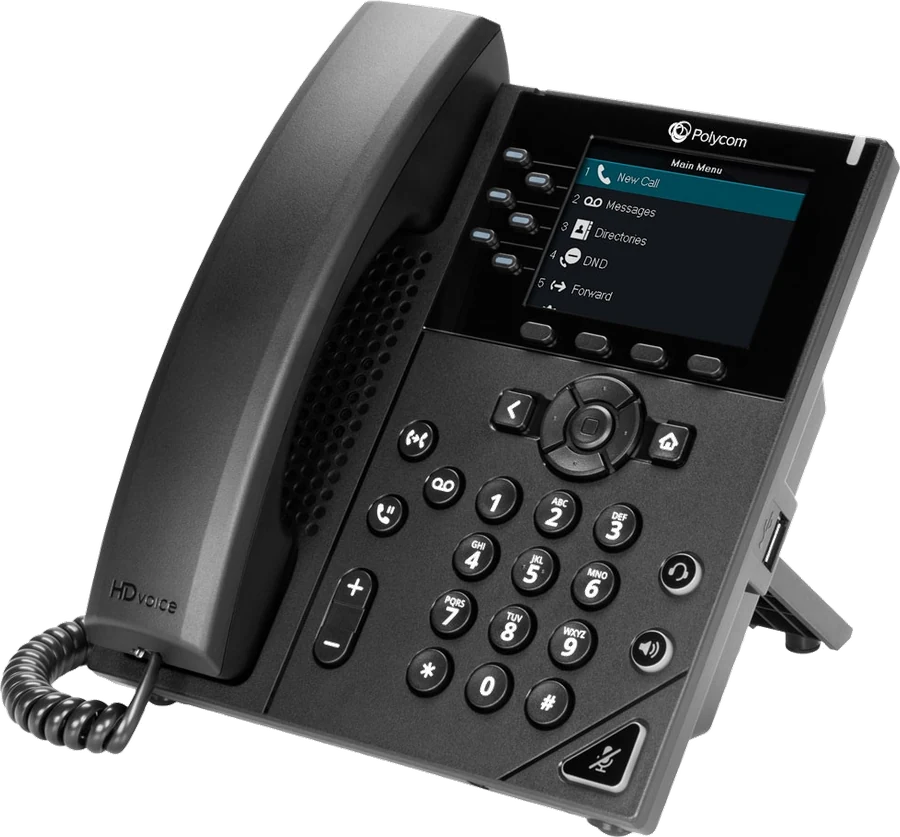
- Any SIP desk phone — Poly, Yealink, Grandstream, Cisco
- Handsets the practice already owns, rather than a drawer
- A softphone on a laptop, with no hardware at all
- A phone browser, which is how the screens further down were captured
RootVoice is standard SIP, so a desk phone is just a desk phone. You buy it from a reseller and own it outright, the same principle as the number. We do not lease you hardware and we do not make the phone the reason you cannot leave.
Stated plainly, because it is the largest gap in the voice stack: there is no auto attendant yet. Calls ring the lines you route them to. Everything above is live.
Charting, consent and imagery that feed the revenue chain.
The consultation workspace, consent and photographs live in RootLogic because the quote, the invoice and the attribution all hang off them. Anything else stays in the system you chart in today. You are not being asked to move your clinical records to buy a phone system.
Consent with per-clause initials
Each clause initialed separately and the document frozen at signature, so what was agreed to is reconstructable years later.
Six angles, every timepoint
A fixed pathway rather than whatever the camera caught, which is what makes a twelve-month comparison worth showing a patient.
Regions, density and area
The graft planner displays its total rather than asserting it, and the counted figure is never written from an estimate.
An append-only access log
Who opened which record and when, kept as a record rather than as a setting somebody can turn off.
Medications and allergies, properly
Each medication carrying who is responsible for it, a reconciliation date, and an assertion of no known allergies kept distinct from nobody having asked.
On prescribing, exactly: RootLogic does not transmit prescriptions and there is no contracted eRx vendor, so nothing on this page is an e-prescribing claim. What it holds is the substrate one is negligent without — the medication list with an origin on every row, allergies, prescriber credentials down to EPCS and PDMP enrolment, and a record of which screening ran and what it said. We will never ship an interaction database: that is licensed clinical decision support, and a screen implying a check with nothing behind it is worse than no screen.

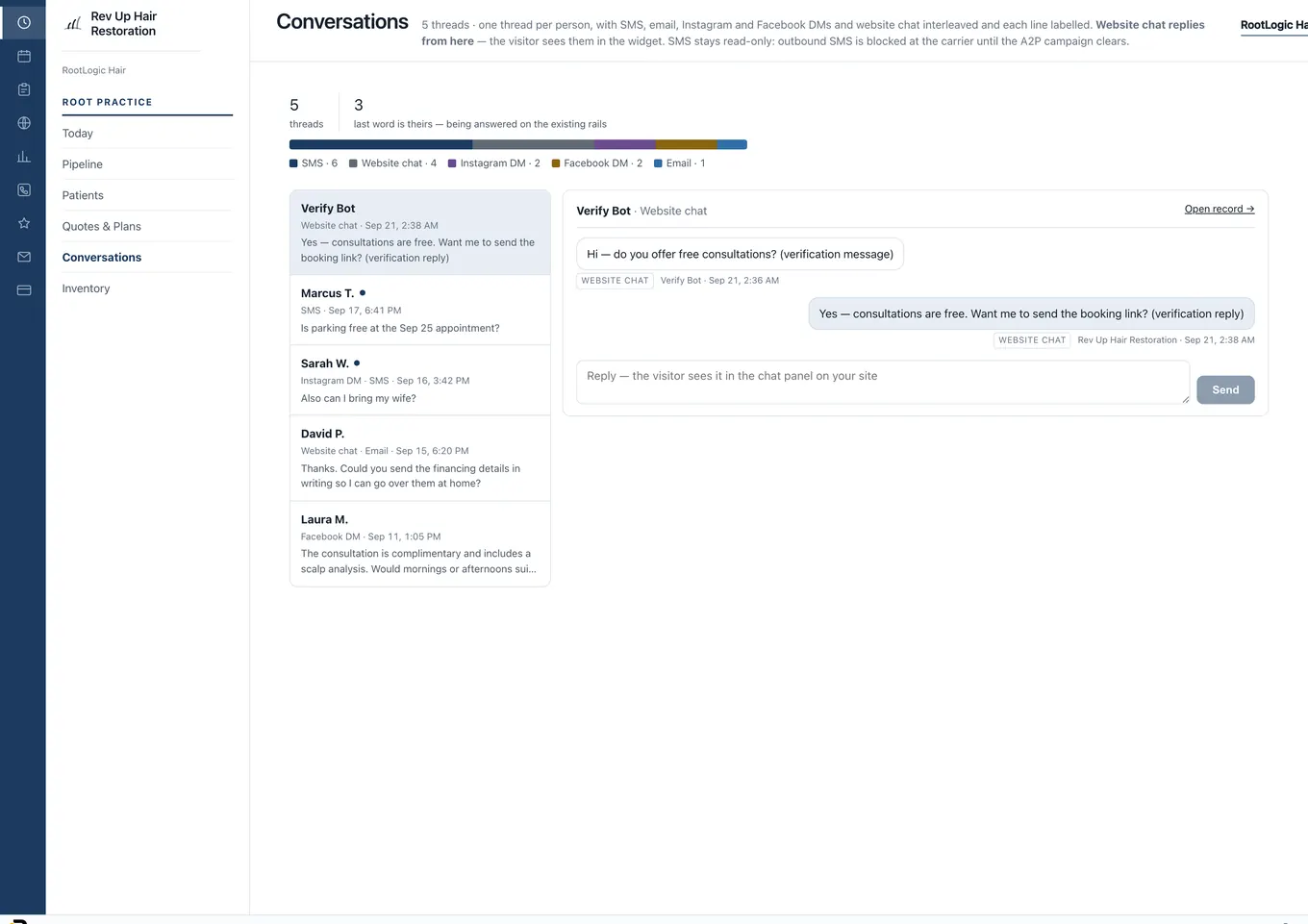
SMS, email, Instagram, Facebook and website chat, per patient.
One record, not two leads and a mystery
One thread per person with each line labeled by the channel it arrived on. The patient who direct-messaged you in March and called in October is one person on one record.
Website chat is answered from the same thread, and the visitor sees the reply in the widget on your site.
Quoted and still sellable is the number that runs the month.
A hair practice rarely has a lead problem. Consultations happen, quotes go out, and a meaningful share never become a date on the calendar. The leak is the call nobody answered well, the consultation nobody followed up and the quote nobody chased.
Card processing through RootPay is gated on entity and payments onboarding and is not open to every practice yet. Quotes, invoices, deposits and plans are live now and work against whatever you take payment with today.
One feature, and a list of what we will not do.
Every recorded call is analyzed and the score carries its reasoning. A number without an explanation cannot be coached on, and a scoring system nobody can argue with is not worth having.
What it does
- Reads every call rather than the handful somebody remembered
- Says whether the consultation was actually asked for
- Carries the reasoning behind the score, so it can be coached on
- Leaves the qualified verdict itself a rules decision you can read
What it does not do, on purpose
- No ambient scribe listening in the room
- No diagnostic output of any kind
- No AI answering the phone in place of your front desk
- No patient-facing agent writing to a patient as you
$399 a location a month. Adding a provider changes nothing.
Founding pricing, locked for twelve months, month to month after that. The comparison is not that we are cheaper, because cheaper plans exist. It is that the cheaper plan meters the thing a growing practice does most, which is add people.
per location, per month
Every provider, every user, the phone system and ad attribution included. A second location is a second $399.
per seat
Hiring a surgeon, a patient coordinator or a second front desk changes nothing on the invoice.
months locked
Then month to month. We will not quietly raise a locked price at month thirteen.
What everyone else publishes
- Aesthetic Record: $15 to $19 per user, per month
- AestheticsPro: $85 per month for every user beyond two, on its entry plan
- Mangomint: $10 per additional user, $70 per phone line, $120 per additional location
- Boulevard: $45 per prescriber to prescribe, $65 per location for forms
- RootLogic: $399 per location. Adding a provider changes nothing.
Each line is a rate the vendor prints on its own pricing page, read 2026-09-22. We do not publish a competitor total, because the configurations are not comparable and the totals move. The full price page.
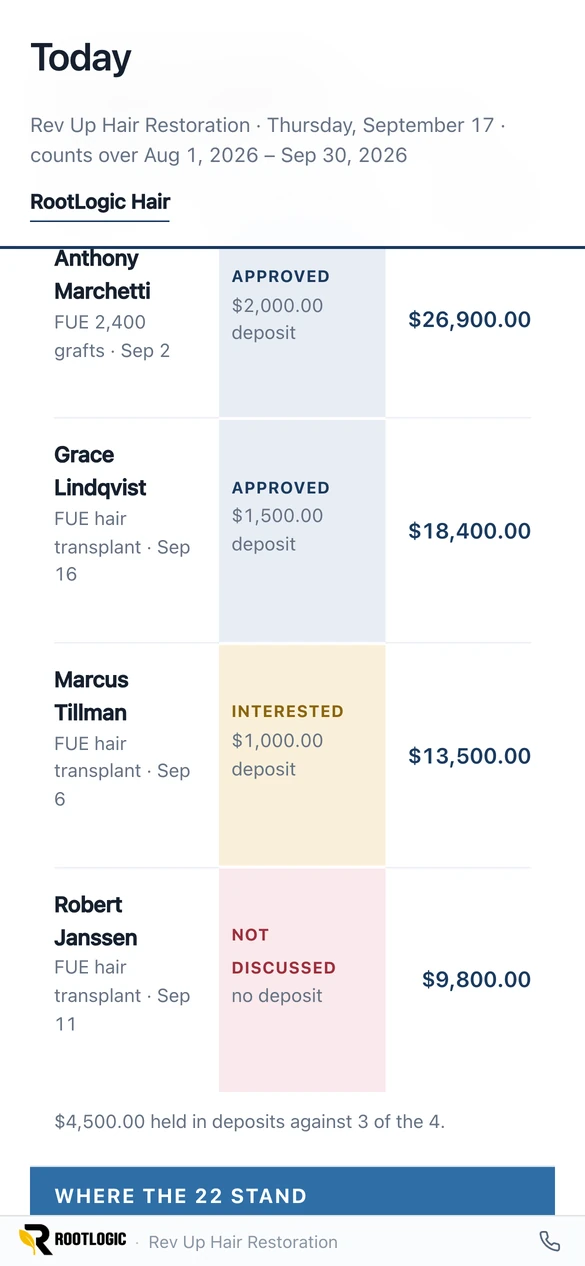
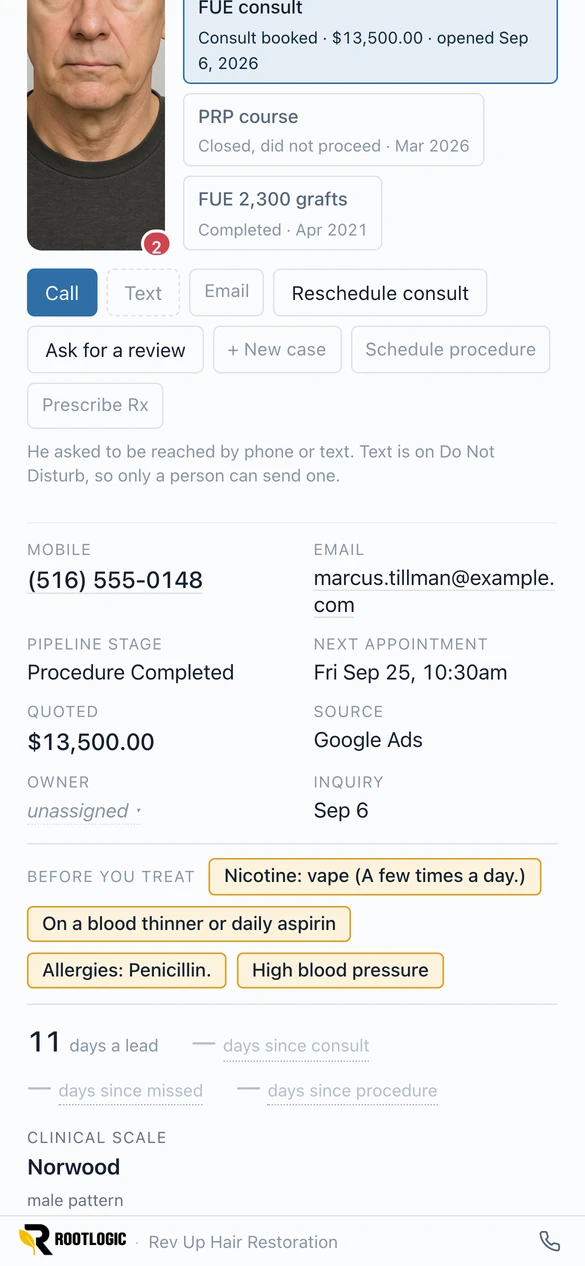
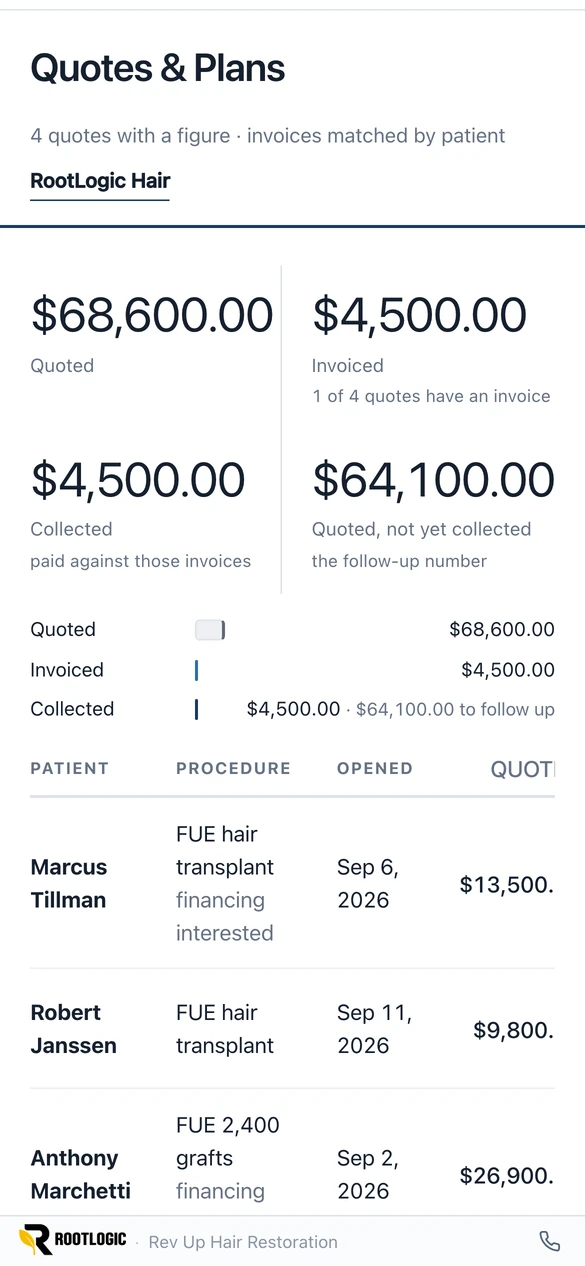
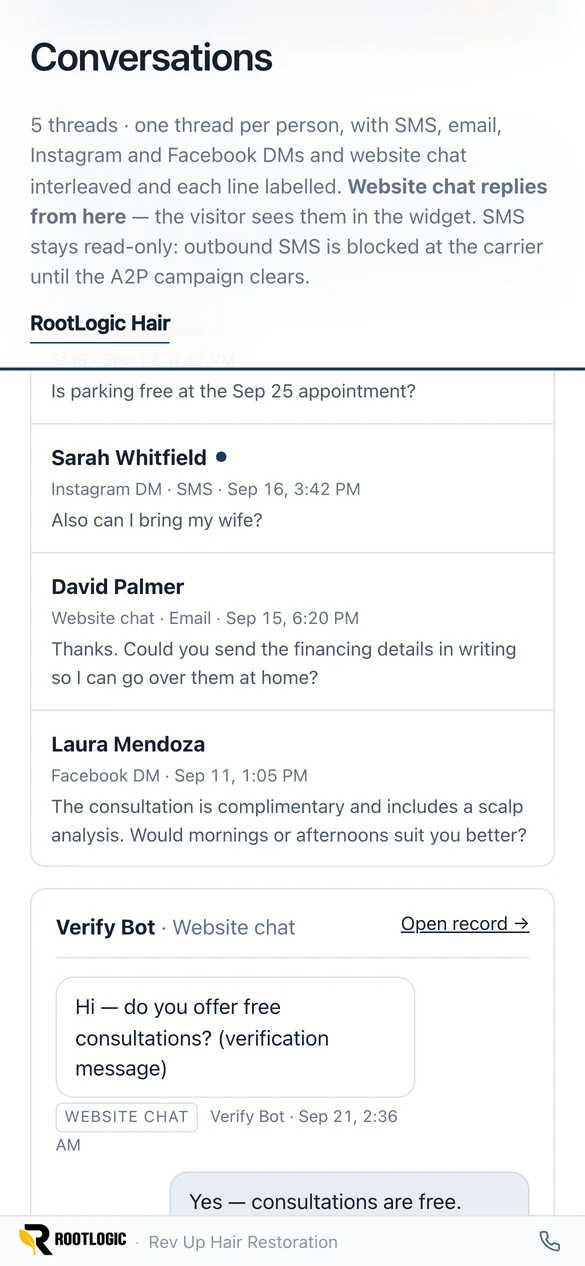
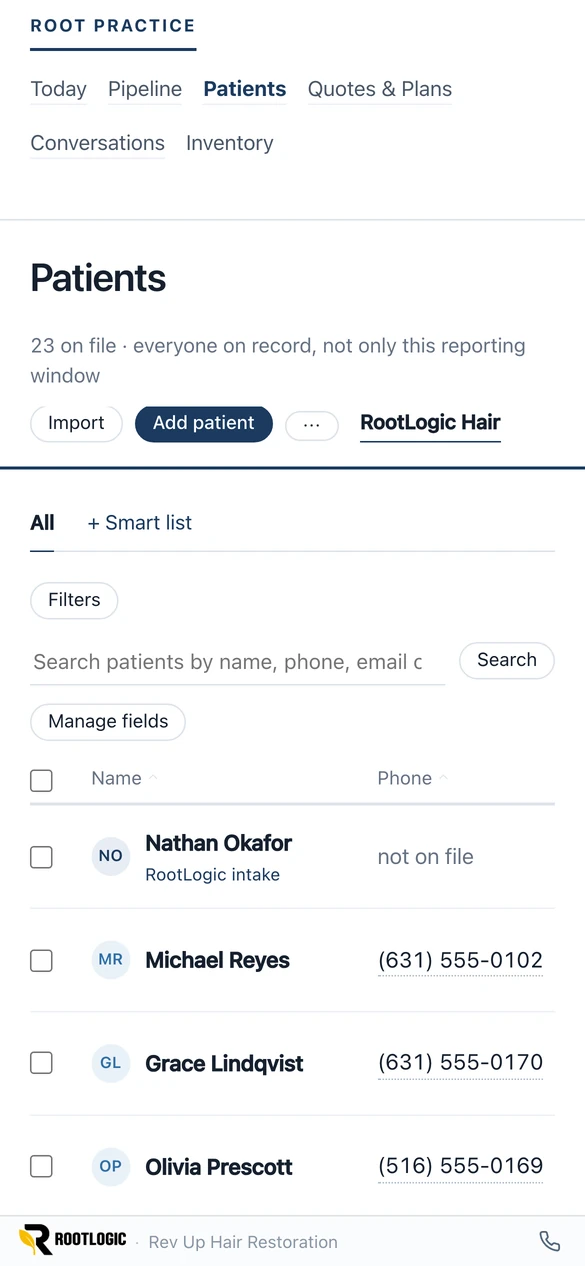
The same tenant, in a pocket.
Captured in a real 390-pixel iPhone viewport on the public demo tenant, not a desktop screen shrunk into a frame. To be exact about what ships: this is the web app in a phone browser. A native iPhone app is being built and is not released, and this page will say so until it is.
Four steps, and you start on a built practice.
Nothing here asks you to move a clinical history to answer the phone better, and nothing asks you to configure a system from an empty screen.
Open the demo
No form and no call. It is a working tenant on synthetic data and you can click anything in it.
Tell us about the practice
Name, vertical, locations, providers and what you run today. Four lines is plenty and you get a real answer back, not a sequence.
We stand it up on the hair pack
Not an empty database. The pack ships the service shapes, the pipeline and its ageing rules, the questionnaire and the answer vocabularies, already built. Numbers ported or provisioned, historical leads loaded, ad accounts connected.
Launch, and keep your chart
The consultation workspace, consent and imagery move because the revenue chain needs them. Everything else stays where it is.
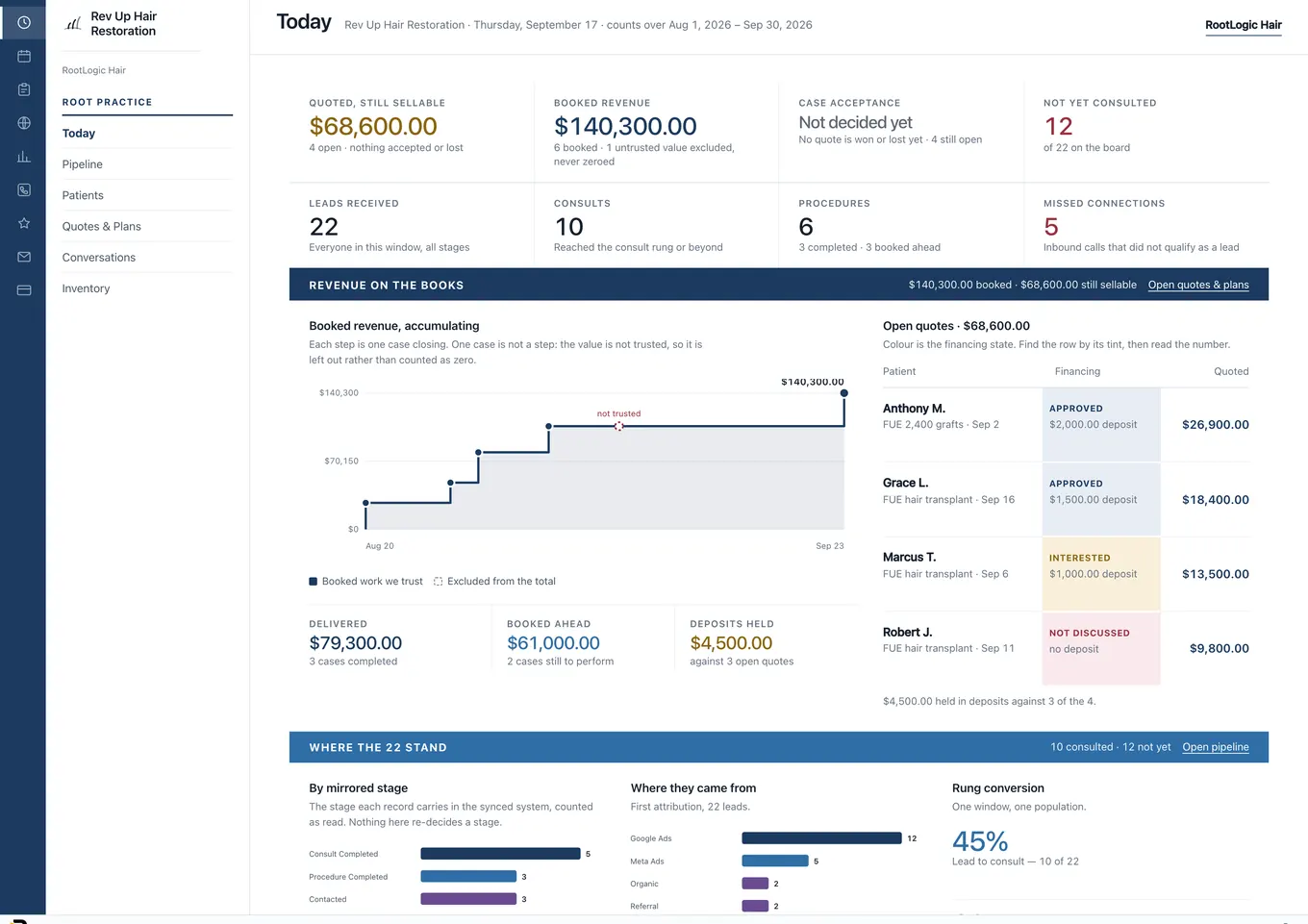
The pack arrives built, not as an empty database.
Every practice-management migration you have done started with somebody configuring a blank system for six weeks. A vertical pack is the opposite of that: it ships what a hair practice is made of, and a practice edits it rather than inventing it.
service shapes
Consultation, two surgical, two non-surgical, deposit and retail, each carrying a clinical name, a marketing name and an accounting name.
pipeline stages, with their rules
Each one with the event it is anchored to, how long a card may sit there, who owns it, and what happens when that runs out.
answer options
The vocabularies behind the questionnaire and the record — motivation, urgency, financing, decision stage, concerns — so answers are reportable instead of free text.
What a template is, and is not
- Six questionnaire modules, assembled per practice from its own service catalog rather than a fixed list
- The pipeline, pre-staged, with an owner and a breach rule on every column
- The consultation workspace, nine steps, already built around Norwood and Ludwig
- Message sequences defined per stage, each one activated deliberately rather than running the day you arrive
- Your own services added alongside, marked as yours, never overwritten by a pack update
A template ships a shape, never a price. A default dollar figure in a template is a number somebody forgets to change, and your fees are your own business. Editing the pack never touches a practice that already copied it, and a practice editing its own catalog never touches the pack.
Terms the pack models as objects, not as notes.
Every term below is a field, a scale or a state in the software. None of them is a label on a free-text box.
- Norwood–Hamilton
- The seven-stage male pattern scale with the A-variants. Staged in the questionnaire by the patient and in the consultation by the practice, and the two are kept apart.
- Ludwig
- The three-stage female pattern scale, modeled alongside Norwood rather than bolted on. The recorded sex decides which chart applies, and an unrecorded one picks neither.
- Follicular unit
- The natural grouping of one to four hairs. Grafts are counted in follicular units, and graft count stays distinct from hair count.
- Safe donor area
- The occipital and parietal region assessed for supply. Donor density and laxity recorded at consultation, not estimated later.
- Graft yield
- The measured figure at follow-up, stored separately from the pre-operative estimate. Two fields, never one.
- Shock loss
- Temporary post-operative shedding. A documented expectation in consent and a labeled stage in the photo pathway.
The questions that actually come up on these calls.
Including the two we get asked most, which are about what you keep and what happens if you leave.
Does this replace the system we chart in?
No, and we would not want it to. The consultation workspace, consent and imagery live in RootLogic because the quote, the invoice and the attribution hang off them. Anything else stays where it is. Nobody has to migrate a clinical history to answer the phone better.
How does the pre-consult questionnaire reach the patient?
As a link, by text or email, tied to the appointment. They fill it in on their own phone before they travel, or on a tablet in the waiting room if they did not. Five steps, about four minutes, and the answers land on the consultation record rather than in an inbox. None of the five is a health question: clinical steps are fenced off from a medical practice in the database, so medications, allergies and pattern are recorded in the room instead.
We already use a general CRM. What does this add?
The clinical objects and the attribution. A general CRM has no concept of a graft allocation, a donor assessment or a Norwood grade, so all of it lives in notes and cannot be reported on. And it cannot tell you which ad produced the case, because the call and the click never met.
Do you do e-prescribing?
No, and we are not going to claim otherwise. There is no contracted eRx vendor and RootLogic transmits no prescriptions. It does hold what a prescribing engine needs underneath it: medications with an origin on every row, allergies with a real assertion of none, prescriber credentials including EPCS and PDMP enrolment, and a record of which screening ran and what it said. We will not write an interaction database — that is licensed clinical decision support, and an interaction check with nothing behind it is a patient-safety defect wearing a feature’s clothes.
What does it connect to?
Google Ads and Meta for the attribution loop, your website for the tracking snippet and the forms, and your own phone carrier for the number. The clinical record is deliberately NOT one of them — nothing here reaches into the system you chart in, and nothing needs to. What connects, and what does not.
Can more than one surgeon use it?
Yes, and users are not metered. Each consultation carries its author, so you can see conversion by consulting surgeon without that costing you anything per seat.
Do we have to move our phone number?
You can port it in or keep what you have and point it at us. Either way the number belongs to the practice and ports out again whenever you want it to. There is no auto attendant yet, which is the one thing in the voice stack worth knowing before you decide.
Is there a BAA, and where does patient data sit?
A BAA is signed before any patient data moves. What is stored, where, and which subprocessors touch it is published rather than described: see the BAA and the subprocessor list. The questionnaire pictured above carries no analytics tag, no pixel and no tag manager, and the build fails if one appears.
What does it cost, really?
$399 per location per month, founding pricing locked twelve months, month to month after that. Every provider and user is included, as is the phone system with five numbers or extensions and 2,000 talk minutes. Usage past that is billed at carrier cost, itemized, with no markup. The full price page.
What happens if we leave?
Full data export, any time, no exit fee, and the phone number ports out. We would rather lose a customer than hold one with a hostage.

Two ways in, and neither of them is a form.
Open the product yourself, or tell us about the practice in six lines and get a real answer back from a person.
Pick whichever one you would rather do first.
Open it yourself, right now
A working tenant on synthetic data. No email, no call, no waiting. Start on Today, then the pipeline, then source to revenue, then ask your current vendor for that last screen.
Open the live demo →Or tell us about the practice
Founding cohort access is open. Send these six lines and a person reads it and replies with a real answer, including no when the answer is no.
- Practice name
- Website
- Locations
- Surgeons and providers
- What you run today
- Best number